Tech Center, Lampire Link Unique

by Erin Thompson, Gazette Staff Writer; Gazette Photo/Erin Thompson

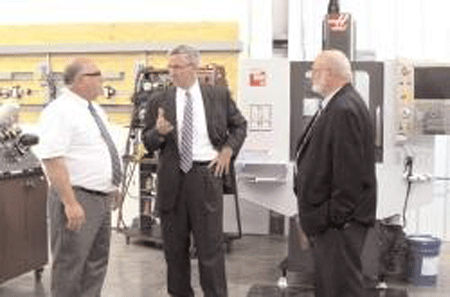
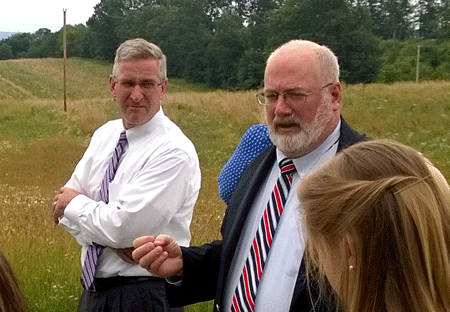
EVERETT — Pennsylvania Secretary of Agriculture Russell Redding said he would like Pennsylvania to lead by Bedford County’s example when it comes to preparing young people for the work force.

Specifically, Redding is interested in the link between the Bedford County Technology Center and Lampire Industries and how they work together to integrate education with the job market, he said Thursday when he toured both facilities.

The secretary said there is a misconception with the word “agriculture,” which may deter people from entering the field.

“Agriculture is difficult to define,” he said, adding that many relate the word to farming, but that the “industry is full of opportunity.”

“It’s food. It’s society. It’s civics. It’s science. It’s natural resources — the definition is open ended, but it’s not simply production,” he said.

The technical center serves all six schools in Bedford County, according to Administrative Director David DiPasquale, who added that the center serves middle school and high school students. The center, he said, also recently added an internship program where students can work with Lampire Industries to gain more “hands-on experience.”

Not only did the technical center receive a $103,000 grant from Appalachian Regional Commission recently, its director said the technical center’s enrollment is up.

“Right now, we’re exploding,” said DiPasquale, adding that some students have had to go into their second or third choice of program. “We’re very close to capacity.”

Technical center biotechnology Instructor Scott Myers said when it comes to the agricultural workforce, “there’s got to be a connection between the workforce and academic progress.”

Myers said the program “gives (students) an idea of what they want to do before they spend money on college. Our biotechnology program allows them to see the opportunities that are out there.”

Redding said there is a need for more education in this field, explaining that only one-third of Pennsylvania schools currently have an agriculture science program.

“This limits their opportunity for career exploration,” said Redding. “There are a lot of folks out there who need those good solid skills.”

This is why the technical center and Lampire’s model is intriguing to Redding, he said.

“We want to learn from you on the integration, with the job piece being the outcome,” he said. “We’re trying to figure out how to do that because Bedford County has done it and done it well.”

Lampire President Gregory Krug discussed some of the functions of Lampire and why they are interested in employing young people.

“Training takes a long time and costs a lot of money,” said Krug. “We want to develop a workforce that will have longevity” with the company.

Krug said interacting with the tech center has offered opportunities for both parties that neither would normally have.

“We feel working with the school helps us a way to develop a workforce and gives them and idea of what is needed in this industry,” Krug said.
Local Company Plays Role in New Medication

by Christian Heilman; WeAreCentralPA.com / WTAJ

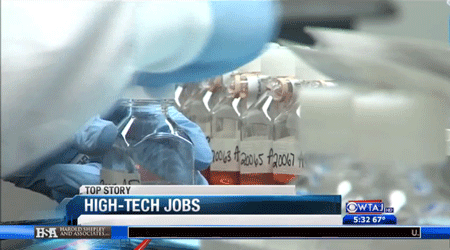
EVERETT, BEDFORD COUNTY — Lampire Labs in the Everett area is getting a big boost with a $5 million contract. They will help in making new arthritis medication that will be sent worldwide. It’s the latest step of expansion for this high tech business.

Rebecca Stickel will be one of the newest employees at Lampire Labs.

Rebecca Stickel, Lampire Biological Laboratories, said, “In my heart I knew this was the job I wanted to do.”

But the Bedford High School graduate never thought her job would be so close to home.

“I just never really knew about this company so it was just kind of a big eye-opener,” she said.

The company called Bedford County home in 1989 with hundreds of acres of farmland. They take blood, milk or eggs from animals and send it to their lab. It can end up in different drugs or tests — like a pregnancy test.

Gregory Krug, President and CEO, said, “We are like what the coal mine is to the steel industry. We supply the raw materials to the life science industry.”

In 2007, they expanded to this building in the Everett Business Park. It used to be a textile factory filled with sewing machines — now, it’s a lab. And half of the company’s 120 employees call Bedford County home.

Krug said, “We’re here to stay. We’re looking to grow, expand and keep on expanding. “

They already are. A new $5 million contract with a Fortune 50 company means about $1 million in renovations to their warehouse and adding six new employees.

“We’re developing a workforce here,” said Krug.

It’s a workforce that will include Stickel — who started working here in high school through the county’s senior challenge program. It partners students with businesses so they can find their fit.

” I’ve been looking at jobs everywhere and for me to be able to find something here was really a blessing,” Stickel said.

The CEO says the partnerships they have with schools is one of the big reasons they decided to move and stay in our region.

Click here for full story.

PA Secretary of Agriculture Visits Lampire

Lampire Biological Laboratories was honored to host a visit from Pennsylvania Secretary of Agriculture, Russell C. Redding on Thursday, June 25th.

Secretary Redding toured our Everett, PA facilities, witnessing first-hand the direct impact of our collaboration with the Bedford County Technology Center. Lampire and the BCTC were recently awarded the 2015 Education Workforce Leadership Award for the collaboration efforts.

Throughout the day Secretary Redding was able to visit the BCTC and then tour our Biotechnology and Processing Laboratory, as well as our 400 acre Pharm Campus where students have the ability to interact one-on-one with our personnel, facilities, and systems. The education model has been extremely successful and is being looked at for new possibilities across the state.

Governors Achievement Award Comes to Bedford County

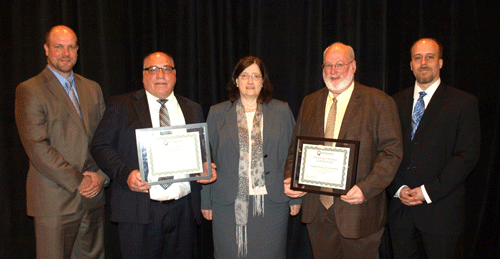
Lampire Biological Laboratories and Bedford County Technical Center were recently presented with the 2015 Education Workforce Leadership Award. The award was given in front of a large crowd attending the annual Pennsylvania Workforce Development Association Conference in Hershey, PA.

“The partnership between Lampire Biological Laboratories and Bedford County Technical Center demonstrates one of the multiple pathways to workforce success for Pennsylvania students,” Acting Secretary of Education Pedro A. Rivera said, “Partnerships like this benefit the company, the student, and the entire community. This collaboration is a strong example for other communities that want to pursue similar partnerships, where students can engage in work-based learning to meet the demands of local industry.”

Lampire Biological Laboratories and the Bedford County Technical Center have had a long standing relationship. Mr. Krug said, “Programs, like Biotechnology, at the Bedford County Tech Center are vital for the sustainability of businesses like Lampire because they cultivate the talent to work in this highly technical environment.” “This is not your old VoTech program anymore; it has evolved into something much greater. Students have options when they graduate from the Technical Center.” “They can go right into the workforce or on to college.”

“Another unique thing about BCTC is their partnership with Allegany College of Maryland. It is a wonderful resource to have a technical center and community college working side by side. Students can attend college and earn a degree, right here in their own back yard.” Noted Krug.

Gregory F. Krug and Lampire were instrumental in helping Dr. Allen Sell, Mr. Thomas Wakefield, Mr. Wayne Koontz and others realize the vision for a high tech training facility for the Agricultural and Life Sciences.

The Pennsylvania Workforce Development Association, the voice of the Pennsylvania workforce investment system and a clearinghouse for workforce development information statewide, sponsors this annual conference, which attracts more than 1000 private and public job training experts from across Pennsylvania.

(Pictured) – Receiving the award from Lampire are (From Right) Laboratory Manager, Gary Klinger, President, Gregory F. Krug, General Manager, Lee Kandt (Not in Photo). The award was presented by the State Director of the Bureau of Career and Technical Education, Dr. Lee Burket (Center). Receiving the award from the Technical Center are Administrative Director, David DiPasquale and Biotechnology Instructor, Scott Myers.

Mourning the loss of a Founding Board Member

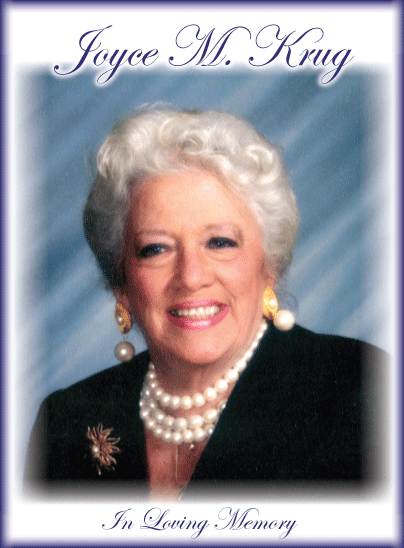
It is with great sadness, that we mourn the loss of a Lampire family member. Joyce M. Krug, who served as Treasurer and was a founding Board Member, passed away on Tuesday, April 28, 2015 with family by her side. She was 88.

She was the beloved wife of the late Frank R. Krug, they shared 47 years of marriage.

She is survived by her daughter, J. Meredith,
and son, Gregory (Diane). She was the dear
sister of Jean Peters and cherished grandmother of Frank, Craig, Johann, Brendan and Brady. Her grandsons lovingly referred to her as “Sweetheart”.

Born in New York, Joyce graduated from Sewanhaka High School in Floral Park. In her early career, she graced the pages of New York City magazines as a fashion model for Franklin Shops and other retailers. Joyce also designed the world-renowned window displays for Macy’s on 34th Street.

She was a real estate agent for 40 years in Garden City. She was on the Board and Treasurer for Lampire Biological Laboratories, Inc. in Pipersville, Pa. for 38 years.

Joyce was an avid antique collector, enjoyed rug hooking and spending time with her family, especially on the beach.

Friends may call from 2 to 5p.m. and 7 to 9:30p.m., Friday, at the Thomas F. Dalton Funeral Home, 29 Atlantic Avenue, Floral Park, N.Y. Joyce’s funeral Mass will be celebrated at 9:30a.m., Saturday, at St. Joseph R.C. Church on Franklin Avenue in Garden City. Interment will take place in Holy Rood Cemetery.

In lieu of flowers, donations would be appreciated in Joyce’s name to the Scholarship Fund of Regina Academy at St. John the Baptist School, 4040 Durham Rd., Ottsville, PA 18942.

State Of Innovation: The Next U.S. Medtech Hotspot

by Jim Pomager – MED Device Online

Minnesota. California. Massachusetts.

Ask someone to list the top U.S. states for medtech activity, and these are the names you will usually hear (in some order). And for good reason – many of the biggest and most-recognizable companies in the industry are based in these three states, and much of the world’s medical device and diagnostics technology originates from them.

But another state has quietly positioned itself to join the ranks of the medtech elite. It is home to 600+ firms in the medical device and diagnostics sector (per Pennsylvania BIO), including the U.S. headquarters of giants Siemens Healthcare, B. Braun, Synthes, and Olympus. It employs more than 22,000 people in medtech jobs – more than any state outside the “big three” (and only 1,700 fewer than mighty Massachusetts) – according to data published by AdvaMed. Over $13 billion of the state’s economy is attributable to the medical technology industry.

Which state is it? I’ll give you two final hints: 1) Along with Massachusetts, it is one of only four U.S. states that designate themselves as “commonwealths”, and 2) I’m sitting in the state as I type this.

That’s right – it’s Pennsylvania, the next big thing in U.S. medtech.

I can understand if you’re skeptical. I was too, at least until I spent three straight days running around the state last month, visiting and talking with numerous medtech companies during a whirlwind media tour of the Pennsylvania life sciences industry…

…In many parts of the state, industry is collaborating with local academia to begin preparing students for life science careers as early as middle and high school. One creative example is in Central Pennsylvania, where the Bedford County Technical Center, a shared time career and technical school, has formed a partnership with Lampire Biological Laboratories (Ottsville), a company specializing in polyclonal and monoclonal antibody development, cell culture devices and services, and blood-derived products. Lampire helped build and equip laboratories at the school, and consulted on biotechnology curriculum to better prepare students for careers at Lampire and other regional life science organizations…

For the full article please click HERE

Lampire Revolutionary

{“preview_thumbnail”:”/sites/default/files/styles/video_embed_wysiwyg_preview/public/video_thumbnails/HwQsObcB35E.jpg?itok=5rM_9jY1″,”video_url”:”https://www.youtube.com/watch?v=HwQsObcB35E”,”settings”:{“responsive”:1,”width”:”854″,”height”:”480″,”autoplay”:1},”settings_summary”:[“Embedded Video (Responsive, autoplaying).”]}

Lampire Biological Labs is committed to building the biotech industry in Bedford County, PA. This is exhibited by collaborating with Bedford County and area educational centers to educate the future work force in the life science industry.

Zebrafish Consortium Update – Phase II Results Published

Lampire’s continued participation in a multi-pharma consortium, whose goal is to develop a harmonized zebrafish developmental toxicity assay, has resulted in a second publication. This manuscript, which appears in Toxicological Sciences, focuses on the predictivity of this assay in determining the teratogenicity of 38 proprietary pharmaceutical compounds using an optimized protocol.

Abstract: Fishing for Teratogens: A Consortium Effort for a Harmonized Zebrafish Developmental Toxicology Assay.

Ball JS, Stedman DB, Hillegass JM, Zhang CX, Panzica-Kelly J, Coburn A, Enright BP, Tornesi B, Amouzadeh HR, Hetheridge M, Gustafson AL, Augustine-Rauch KA

A consortium of biopharmaceutical companies previously developed an optimized Zebrafish developmental toxicity assay (ZEDTA) where chorionated embryos were exposed to non-proprietary test compounds from 5 to 6 h post fertilization and assessed for morphological integrity at 5 days post fertilization. With the original 20 test compounds, this achieved an overall predictive value for teratogenicity of 88% of mammalian in vivo outcome [Gustafson, A. L., Stedman, D. B., Ball, J., Hillegass, J. M., Flood, A., Zhang, C. X., Panzica-Kelly, J., Cao, J., Coburn, A., Enright, B. P., et al. (2012). Interlaboratory assessment of a harmonized Zebrafish developmental toxicology assay-Progress report on phase I. Reprod. Toxicol. 33, 155-164]. In the second phase of this project, 38 proprietary pharmaceutical compounds from four consortium members were evaluated in two laboratories using the optimized method using either pond-derived or cultivated-strain wild-type Zebrafish embryos at concentrations up to 100μM. Embryo uptake of all compounds was assessed using liquid chromatography-tandem mass spectrometry. Twenty eight of 38 compounds had a confirmed embryo uptake of >5%, and with these compounds the ZEDTA achieved an overall predictive value of 82% and 65% at the two respective laboratories. When low-uptake compounds (≤5%) were retested with logarithmic concentrations up to 1000μM, the overall predictivity across all 38 compounds was 79% and 62% respectively, with the first laboratory achieving 74% sensitivity (teratogen detection) and 82% specificity (non-teratogen detection) and the second laboratory achieving 63% sensitivity (teratogen detection) and 62% specificity (non-teratogen detection). Subsequent data analyses showed that technical differences rather than strain differences were the primary contributor to interlaboratory differences in predictivity. Based on these results, the ZEDTA harmonized methodology is currently being used for compound assessment at lead optimization stage of development by 4/5 of the consortium companies.

Publication Awarded

Lampire Biological Laboratories, Inc., is pleased to announce that a publication entitled Inter-laboratory assessment of a harmonized zebrafish developmental toxicology assay – progress report on phase I was recently awarded the “Best Manuscript in Reproductive Toxicology, 2012” by the Officers of the European Teratology Society. This publication came as a result of Lampire’s participation in a multi-pharma consortium whose goal is to develop a harmonized zebrafish developmental toxicity assay, and included Senior Toxicologist Dr. Jedd Hillegass as one of its authors. In recognition of this achievement, the European Teratology Society invited a fellow member of the consortium to present this work at the Elsevier Reproductive Toxicology Publication Award Lecture during the 2013 meeting in Stresa, Italy.

Please feel free to contact Lampire to see how our zebrafish embryo culture (ZEC) screening service can assist you in determining the teratogenic liability of your compound of interest. If you would like more information, please contact our Senior Toxicologist, Dr. Jedd Hillegass (jhillegass@lampire.com; 215-766-4901). This assay, along with our rat whole embryo culture (rWEC) assay, are just two examples of the continuing Lampire initiative to provide cost effective in vitro teratogenicity screening assays that conform to the principle of reducing, refining, and replacing animals used in research.